Hologram Generation via Deep Learning for 3D Holographic Display Systems ■
Subject ■
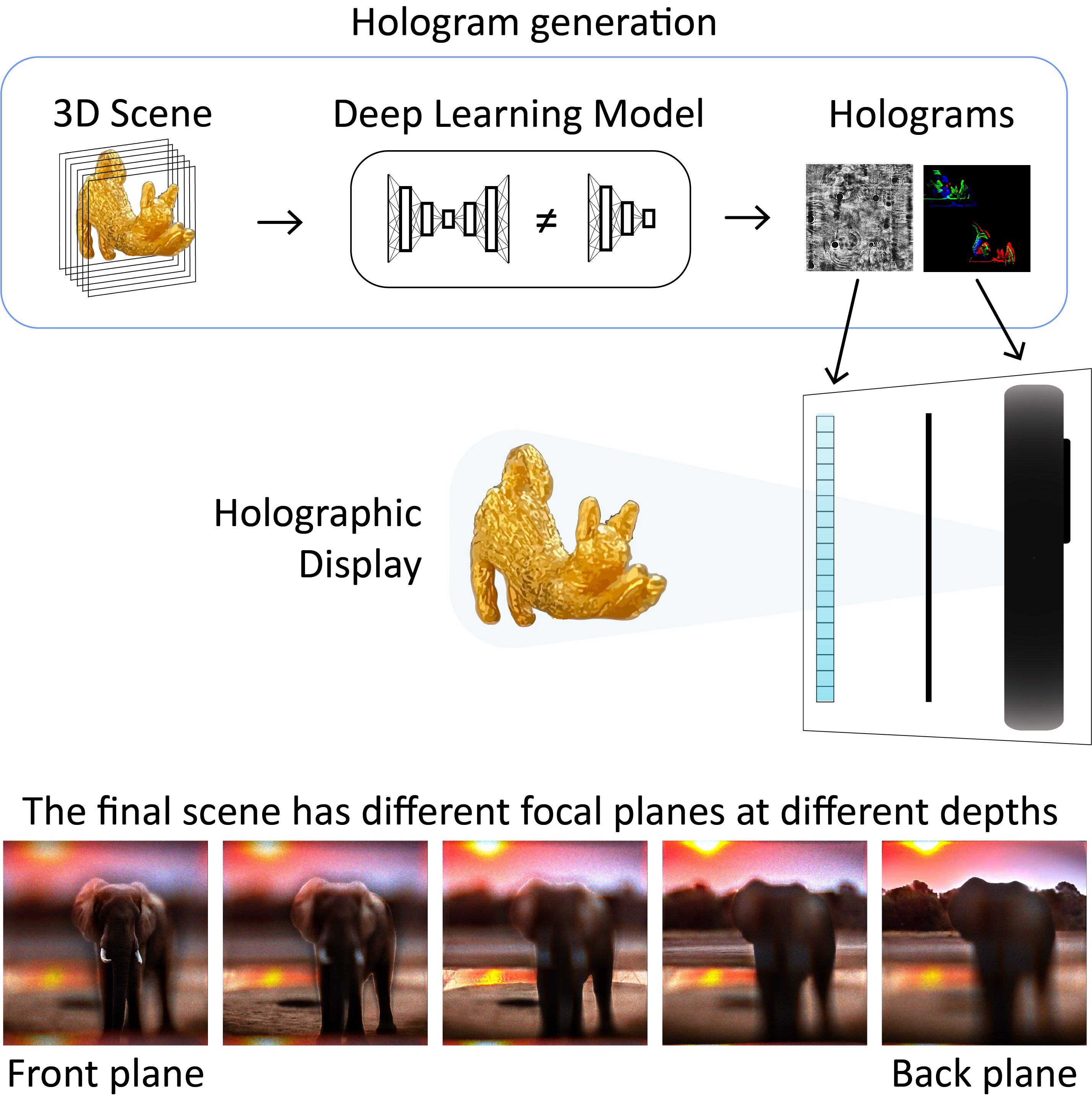
Holographic displays have the potential to become the highest quality type of 3D display systems, as they account for all visual cues by reproducing the full wavefield of light, both amplitude and phase information. Hologram generation for 3D holographic displays is often done using inverse optimization methods. These methods provide accurate results, but they require many iterations to converge, making the process slow. This thesis investigates the application of deep learning models to improve the required computation time of hologram generation in a specific type of 3D holographic display.
Kind of work ■
The student will first study image-to-image deep learning architectures, our hologram generation methods, and our holographic display prototype in our lab. A dataset based on random data will be generated using our forward light propagation model. This dataset will then be used to train different architectures of deep learning models, and their performance will be evaluated using non-random 3D scenes. The work includes programming, working on the optical setup, reviewing literature on computer-generated holography, designing new models for light propagation, and implementing new optimization algorithms.
Framework of the Thesis ■
Montoya, M., Nie, Y., and Blinder, D., “Partially coherent computer-generated holography,” Optica Open
(12 2025).
Huang, L., Chen, H., Liu, T. et al. Self-supervised learning of hologram reconstruction using physics consistency. Nat Mach Intell 5, 895–907 (2023)
(12 2025).
Huang, L., Chen, H., Liu, T. et al. Self-supervised learning of hologram reconstruction using physics consistency. Nat Mach Intell 5, 895–907 (2023)
Expected Student Profile ■
Good knowledge of Python programming and deep learning.