Below you will find frequently asked questions, divided over four different groups. First, a generic FAQ with information applying to a broad set of master degrees and then more specific FAQs applying to specific programs only.
FAQ for all master degrees

“Signal Processing in the AI era” was the tagline of this year’s IEEE International Conference on Acoustics, Speech and Signal Processing, taking place in Rhodes, Greece.
In this context, Brent de Weerdt, Xiangyu Yang, Boris Joukovsky, Alex Stergiou and Nikos Deligiannis presented ETRO’s research during poster sessions and oral presentations, with novel ways to process and understand graph, video, and audio data. Nikos Deligiannis chaired a session on Graph Deep Learning, attended the IEEE T-IP Editorial Board Meeting, and had the opportunity to meet with collaborators from the VUB-Duke-Ugent-UCL joint lab.
Featured articles:
- De Weerdt, B. et al., “Designing Transformer Networks for Sparse Recovery of Sequential Data Using Deep Unfolding” (https://ieeexplore.ieee.org/abstract/document/10094712)
- Yang X. et al., “Relevance Propagation through Deep Conditional Random Fields” (https://ieeexplore.ieee.org/abstract/document/10095075)
- Stergiou A. et al., “Play it back: Iterative attention for audio recognition” (https://ieeexplore.ieee.org/abstract/document/10096532, developed at the University of Bristol)

Johan Stiens gave a lecture @ the atheneum Geel in the framework of PACT
“Technology, Humanity, and the Climate Imperative: Engineering a Sustainable Future”
Climate change is no longer a distant threat—it is a defining reality shaping our planet, economies, and societies. This keynote invites participants to take a bird’s-eye view of the interconnected forces driving this transformation and to explore how technology, data, and global citizenship can converge to create a sustainable future. We begin with critical observations on climate change and its cascading impact on population dynamics and economic resilience. From there, we examine the evolving energy mix, where renewable sources are not just alternatives but imperatives, demanding innovation in materials, transistors, and processors that power both ICT and solar technologies.
As we enter the data era, ICT systems and smart IoT solutions are unlocking unprecedented sectorial benefits—from MedTech and HealthTech to agri-food and construction—while enabling biodiversity and sustainability at scale. These advances are not merely technical; they represent a societal shift toward intelligent, resource-efficient ecosystems. Drawing on decades of experience in sensor technology development and active engagement with global organizations, this talk will challenge academia, industry, and policymakers to embrace technology uptake as a catalyst for systemic change. Ultimately, the question is not only how we innovate, but how we become true global citizens—responsible stewards of the planet we share, and architects of a future where digital intelligence and clean energy work hand in hand to safeguard life on Earth.
𝐌𝐞𝐝𝐓𝐞𝐜𝐡 𝐀𝐜𝐜𝐞𝐥𝐞𝐫𝐚𝐭𝐨𝐫 𝟐𝟎𝟐𝟔 𝐢𝐬 𝐨𝐟𝐟𝐢𝐜𝐢𝐚𝐥𝐥𝐲 𝐎𝐍 🕺with TWO ETRO participants!
🤙 Detailed description: https://lnkd.in/egx7zM4X
𝐎𝐑𝐈𝐎𝐍 with Ioana-Teodora Ouatu & Johan Stiens
𝐓𝐀𝐑𝐂 with Taylor Frantz
⚡️hub.brussels supports hashtag#entrepreneurs who make an hashtag#impact

On April 2nd 2026 at 16:00, Sebastian Amador Sanchez will defend their PhD entitled “Advancing Landmark Localization through Deep Segmentation for Reliable Malalignment Assessment in Lower Limb Radiographs”.
Everybody is invited to attend the presentation.
Johan Stiens has been participating in the 3-day (Jan. 27–29, 2026) national brainstorming session “‘𝗔𝗴𝗲𝗶𝗻𝗴 𝗶𝗻 𝗣𝗹𝗮𝗰𝗲: 𝗔𝗹𝗶𝗴𝗻𝗶𝗻𝗴 𝗧𝗲𝗰𝗵𝗻𝗼𝗹𝗼𝗴𝘆, 𝗖𝗮𝗿𝗲 𝗮𝗻𝗱 𝗣𝗼𝗹𝗶𝗰𝘆 𝘁𝗼 𝘀𝘂𝗽𝗽𝗼𝗿𝘁 𝗮 𝗹𝗶𝗳𝗲 𝗼𝗳 𝗾𝘂𝗮𝗹𝗶𝘁𝘆’”.
The KVAB – Royal Flemish Academy of Belgium for Science and the Arts invited Prof. Dr. Richard Reilly, Professor of Neural Engineering at Trinity College Dublin, as ‘thinker’ for the Thinker’s Programme “‘𝗔𝗴𝗲𝗶𝗻𝗴 𝗶𝗻 𝗣𝗹𝗮𝗰𝗲: 𝗔𝗹𝗶𝗴𝗻𝗶𝗻𝗴 𝗧𝗲𝗰𝗵𝗻𝗼𝗹𝗼𝗴𝘆, 𝗖𝗮𝗿𝗲 𝗮𝗻𝗱 𝗣𝗼𝗹𝗶𝗰𝘆 𝘁𝗼 𝘀𝘂𝗽𝗽𝗼𝗿𝘁 𝗮 𝗹𝗶𝗳𝗲 𝗼𝗳 𝗾𝘂𝗮𝗹𝗶𝘁𝘆’”.
This week, Prof. Reilly is engaging with key stakeholders on the most pressing themes.
✨ SOCIO-ECONOMIC CONTEXT AND OPPORTUNITIES FOR INDUSTRY
We have the technology. But older adults need citizen-centric tech, not tech-centric solutions.
We have the data, but our health data are fragmented and remain siloed. And citizens are left out.
How do we enable safe, ethical data exchange—once, with the citizen at the centre—and base funding on societal ROI?
✨ A NEED FOR A SKILLED HEALTH WORKFORCE – TRAINING
Technology is rapidly reshaping care, but skills must keep up.
New curricula, early interdisciplinarity, user-centred engineering, and guidance for informal caregivers are needed.
And how do we build the talent pipeline that ageing urgently needs, making ageing a career students want to choose?
✨ NUTRITION
Healthy ageing isn’t just about nutrients.
It’s about pleasure, affordability, companionship—and the microbiome.
With world-class food tech research in Flanders, how do we turn science into better ageing in place?
✨ PREVENTION
Falls and dementia are not inevitable; they are largely preventable.
Prevention is our most powerful lever, yet it receives only a fraction of health spending.
What policy frameworks can capture its ROI and drive systemic change to protect our health system?
✨ How can technology support physical and brain health?
How do we deal with:
· sarcopenia monitoring
· housing challenges
· boosting cognitive reserve
· shifting from fall detection to fall prevention
· mastery of sensor data
· person-centred dementia care
· etc.
General
- ETRO_ALL@vub.be (Everyone)
Management
- ETRO_TC@vub.be (ETRO Raad)
- ETRO_RDI@vub.be (ETRO Raad + INDI Professors)
- ETRO_ICT@vub.be (L&M)
- ETRO_Comms_IN@vub.be (Internal communications team)
- ETRO_FARM@vub.be (ETRO FARM users)
Public
- ETRO_Info@vub.be (For external requests)
- ETRO_Comms@vub.be (For external communication requests)
Location-based Lists
- ETRO_K@vub.be (Building K inhabitants)
- ETRO_Ke@vub.be (Building Ke inhabitants)
- ETRO_Pl9@vub.be (Building Pl9 Inhabitants)
Occupation-based Lists
- ETRO_ZAP@vub.be (ZAP Members)
- ETRO_PhD@vub.be (PhD Candidates)
- ETRO_OAP@vub.be (OAP Members)
- ETRO_BAAP@vub.be (BAAP Members)
- ETRO_ATP@vub.be (ATP Members)
- ETRO_Emeriti@vub.be (Emeriti)
On Januari 21st 2025 at 17:00, Fahimeh Akbarian will defend their PhD entitled “INVESTIGATING EXCITATION/INHIBITION BALANCE IN MS THROUGH APERIODIC NEUROPHYSIOLOGICAL ACTIVITY”.
Everybody is invited to attend the presentation in room I.0.01 or online via this link.
Multiple sclerosis (MS) is a chronic central nervous system disease characterised by neuroinflammation, demyelination, and neurodegeneration, leading to physical and cognitive impairments. Cognitive deficits frequently affect working memory, information processing speed, and attention. Although their mechanisms are not fully understood, evidence suggests that synaptic loss, particularly of inhibitory synapses, disrupts cortical excitation–inhibition (E/I) balance and contributes to cognitive dysfunction.
In this PhD project, we used magnetoencephalography (MEG) to investigate changes in the aperiodic 1/f spectral slope, a proposed marker of cortical E/I balance. A steeper slope indicates increased inhibition or reduced excitation. MEG data from healthy controls (HCs) and people with MS (pwMS) were analysed during resting-state, visuo-verbal n-back, and auditory oddball tasks. Data were source reconstructed, parcellated into 42 brain regions, and decomposed into periodic and aperiodic components using the specparam algorithm. Neuropsychological assessments measured information processing speed, verbal fluency, and visuospatial memory.
During resting-state, pwMS taking benzodiazepines showed steeper slopes in occipital, temporal, and prefrontal regions compared with pwMS who did not take benzodiazepines, independent of beta power, supporting the slope as an oscillation-independent measure. Among pwMS who did not take benzodiazepines, those with cognitive impairment displayed steeper slopes than cognitively preserved pwMS and HCs, suggesting compensatory overinhibition mechanism.
In the n-back task, a consistent post-stimulus steepening (increased inhibition) was observed across participants. However, pwMS showed flatter slopes following distractors, consistent with impaired inhibitory control. Greater task-induced steepening predicted better visuospatial memory in pwMS, whereas the opposite relationship was observed in HCs.
In the auditory oddball task, slope steepening persisted even after correcting for event-related fields. Salient stimuli induced stronger steepening, and trials needed response showed enhanced sensorimotor steepening. Slope modulation was correlated across oddball and n-back tasks, suggesting a trait-like index of cognitive control.
Overall, the 1/f slope captured both tonic and phasic inhibitory dynamics, differentiated medication effects, correlated with cognitive performance, and generalised across paradigms. These findings support its potential as a non-invasive biomarker for cognitive dysfunction in MS, warranting further longitudinal and multimodal validation.
De Vrije Universiteit Brussel wil met een supercomputer rampen zoals de waterbom in Wallonië van 4 jaar geleden, beter kunnen voorspellen. De nieuwe supercomputer kan met AI de informatie die radars en satellieten leveren sneller verwerken en zo sneller updates geven over de weersomstandigheden.
https://www.vrt.be/vrtnws/nl/2025/11/30/supercomputer-rampen-waterbom
Hiva Houshyar participated in the final pitch event of the FARI AI Accelerator and presented her business idea and her pitch was selected as “Best Pitch” by the jury! 🎉
Her project, BB-GO, is building a navigation platform tailored to wheelchair users, focusing on personalised routing and urban accessibility. The vision is a world where wheelchair users can explore their city with the same confidence as anyone else.
Want to help shape BB-GO or link us to public authorities? Get in touch via Johan.Stiens@vub.be or Seyedeh.Hiva.Houshyar.Yazdian@vub.be
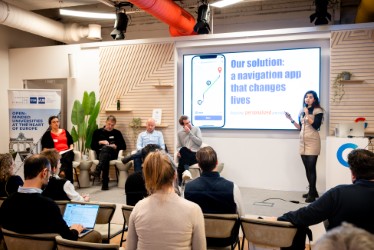
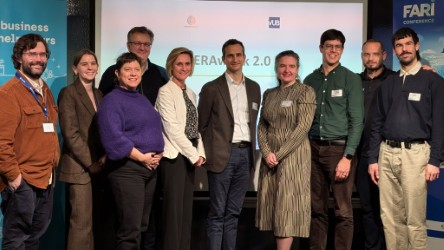
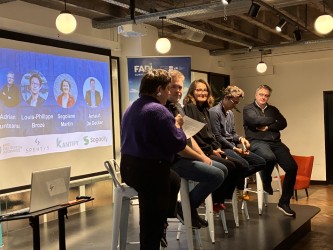
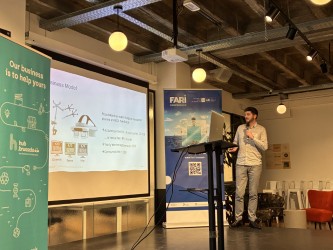
ETRO was highly visible and omni-present at the HealthTech Brussels event hosted by FARI, showcasing cutting-edge AI expertise in health. We hope the networking opportunities helped create valuable new connections with the entrepreneurs and clinicians who attended.
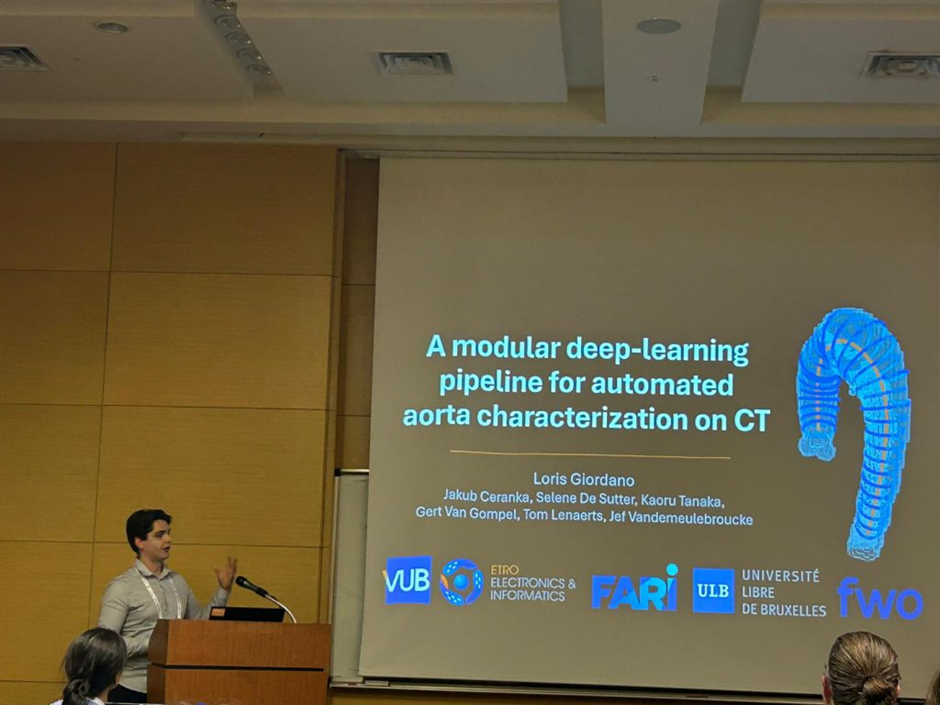
Loris Giordano got the best student paper award at the AMAI workshop of MICCAI 2025 for the paper “A modular deep-learning pipeline for automated aorta characterization on CT”, co-authored by Loris Giordano, Jakub Ceranka, Selene De Sutter, Kaoru Tanaka, Gert Van Gompel, Tom Lenaerts, and Jef Vandemeulebroucke.
Anass Hamdi got awarded an PhD fellowship strategic basic research for his research “AI-driven radiogenomic analysis for spatial glioblastoma subtyping” under supervision of Catharina Olsen, Jef Vandemeulebroucke, Johnny Duerinck and Wim Vranken.
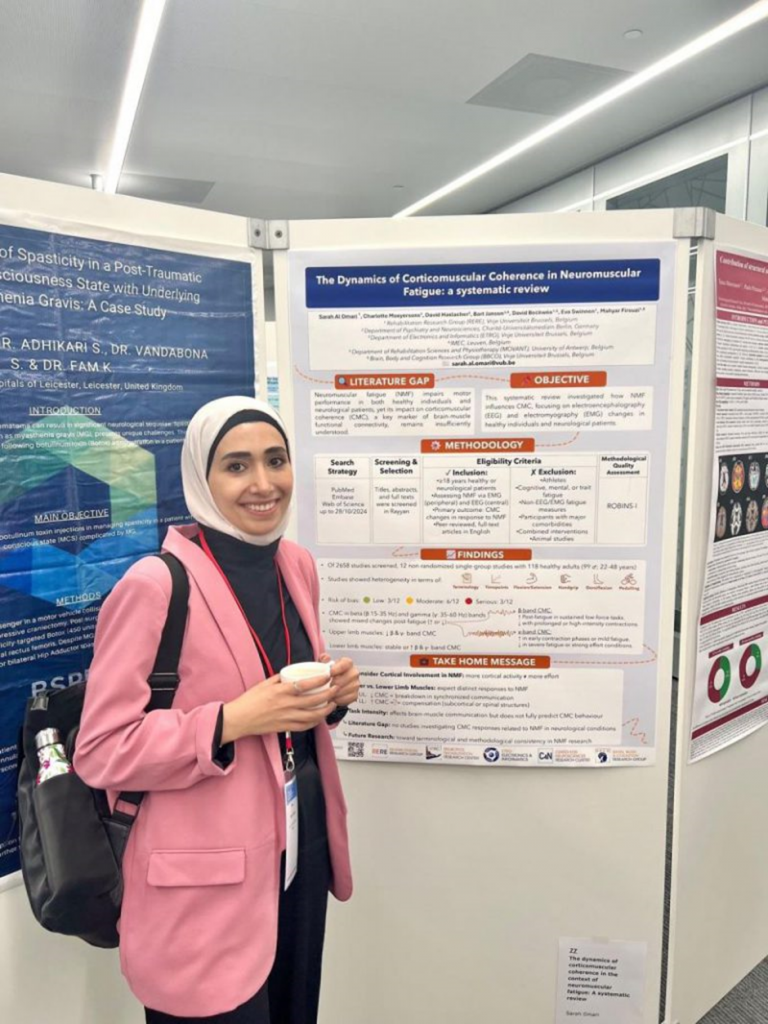
Sarah Al Omari got awarded a PhD Fellowship fundamental research for her research “Exploring Neuromuscular Fatigue in Stroke Survivors: Central-Peripheral Interplay and the Potential of Transcranial Alternating Current Stimulation (tACS)” under supervision of Eva Swinnen, David Beckwée, Mahyar Firouzi and Bart Jansen.
FAQ for the Master Applied Computer Science
“Signal Processing in the AI era” was the tagline of this year’s IEEE International Conference on Acoustics, Speech and Signal Processing, taking place in Rhodes, Greece.
In this context, Brent de Weerdt, Xiangyu Yang, Boris Joukovsky, Alex Stergiou and Nikos Deligiannis presented ETRO’s research during poster sessions and oral presentations, with novel ways to process and understand graph, video, and audio data. Nikos Deligiannis chaired a session on Graph Deep Learning, attended the IEEE T-IP Editorial Board Meeting, and had the opportunity to meet with collaborators from the VUB-Duke-Ugent-UCL joint lab.
Featured articles:
- De Weerdt, B. et al., “Designing Transformer Networks for Sparse Recovery of Sequential Data Using Deep Unfolding” (https://ieeexplore.ieee.org/abstract/document/10094712)
- Yang X. et al., “Relevance Propagation through Deep Conditional Random Fields” (https://ieeexplore.ieee.org/abstract/document/10095075)
- Stergiou A. et al., “Play it back: Iterative attention for audio recognition” (https://ieeexplore.ieee.org/abstract/document/10096532, developed at the University of Bristol)
Johan Stiens gave a lecture @ the atheneum Geel in the framework of PACT
“Technology, Humanity, and the Climate Imperative: Engineering a Sustainable Future”
Climate change is no longer a distant threat—it is a defining reality shaping our planet, economies, and societies. This keynote invites participants to take a bird’s-eye view of the interconnected forces driving this transformation and to explore how technology, data, and global citizenship can converge to create a sustainable future. We begin with critical observations on climate change and its cascading impact on population dynamics and economic resilience. From there, we examine the evolving energy mix, where renewable sources are not just alternatives but imperatives, demanding innovation in materials, transistors, and processors that power both ICT and solar technologies.
As we enter the data era, ICT systems and smart IoT solutions are unlocking unprecedented sectorial benefits—from MedTech and HealthTech to agri-food and construction—while enabling biodiversity and sustainability at scale. These advances are not merely technical; they represent a societal shift toward intelligent, resource-efficient ecosystems. Drawing on decades of experience in sensor technology development and active engagement with global organizations, this talk will challenge academia, industry, and policymakers to embrace technology uptake as a catalyst for systemic change. Ultimately, the question is not only how we innovate, but how we become true global citizens—responsible stewards of the planet we share, and architects of a future where digital intelligence and clean energy work hand in hand to safeguard life on Earth.
𝐌𝐞𝐝𝐓𝐞𝐜𝐡 𝐀𝐜𝐜𝐞𝐥𝐞𝐫𝐚𝐭𝐨𝐫 𝟐𝟎𝟐𝟔 𝐢𝐬 𝐨𝐟𝐟𝐢𝐜𝐢𝐚𝐥𝐥𝐲 𝐎𝐍 🕺with TWO ETRO participants!
🤙 Detailed description: https://lnkd.in/egx7zM4X
𝐎𝐑𝐈𝐎𝐍 with Ioana-Teodora Ouatu & Johan Stiens
𝐓𝐀𝐑𝐂 with Taylor Frantz
⚡️hub.brussels supports hashtag#entrepreneurs who make an hashtag#impact
On April 2nd 2026 at 16:00, Sebastian Amador Sanchez will defend their PhD entitled “Advancing Landmark Localization through Deep Segmentation for Reliable Malalignment Assessment in Lower Limb Radiographs”.
Everybody is invited to attend the presentation.
Johan Stiens has been participating in the 3-day (Jan. 27–29, 2026) national brainstorming session “‘𝗔𝗴𝗲𝗶𝗻𝗴 𝗶𝗻 𝗣𝗹𝗮𝗰𝗲: 𝗔𝗹𝗶𝗴𝗻𝗶𝗻𝗴 𝗧𝗲𝗰𝗵𝗻𝗼𝗹𝗼𝗴𝘆, 𝗖𝗮𝗿𝗲 𝗮𝗻𝗱 𝗣𝗼𝗹𝗶𝗰𝘆 𝘁𝗼 𝘀𝘂𝗽𝗽𝗼𝗿𝘁 𝗮 𝗹𝗶𝗳𝗲 𝗼𝗳 𝗾𝘂𝗮𝗹𝗶𝘁𝘆’”.
The KVAB – Royal Flemish Academy of Belgium for Science and the Arts invited Prof. Dr. Richard Reilly, Professor of Neural Engineering at Trinity College Dublin, as ‘thinker’ for the Thinker’s Programme “‘𝗔𝗴𝗲𝗶𝗻𝗴 𝗶𝗻 𝗣𝗹𝗮𝗰𝗲: 𝗔𝗹𝗶𝗴𝗻𝗶𝗻𝗴 𝗧𝗲𝗰𝗵𝗻𝗼𝗹𝗼𝗴𝘆, 𝗖𝗮𝗿𝗲 𝗮𝗻𝗱 𝗣𝗼𝗹𝗶𝗰𝘆 𝘁𝗼 𝘀𝘂𝗽𝗽𝗼𝗿𝘁 𝗮 𝗹𝗶𝗳𝗲 𝗼𝗳 𝗾𝘂𝗮𝗹𝗶𝘁𝘆’”.
This week, Prof. Reilly is engaging with key stakeholders on the most pressing themes.
✨ SOCIO-ECONOMIC CONTEXT AND OPPORTUNITIES FOR INDUSTRY
We have the technology. But older adults need citizen-centric tech, not tech-centric solutions.
We have the data, but our health data are fragmented and remain siloed. And citizens are left out.
How do we enable safe, ethical data exchange—once, with the citizen at the centre—and base funding on societal ROI?
✨ A NEED FOR A SKILLED HEALTH WORKFORCE – TRAINING
Technology is rapidly reshaping care, but skills must keep up.
New curricula, early interdisciplinarity, user-centred engineering, and guidance for informal caregivers are needed.
And how do we build the talent pipeline that ageing urgently needs, making ageing a career students want to choose?
✨ NUTRITION
Healthy ageing isn’t just about nutrients.
It’s about pleasure, affordability, companionship—and the microbiome.
With world-class food tech research in Flanders, how do we turn science into better ageing in place?
✨ PREVENTION
Falls and dementia are not inevitable; they are largely preventable.
Prevention is our most powerful lever, yet it receives only a fraction of health spending.
What policy frameworks can capture its ROI and drive systemic change to protect our health system?
✨ How can technology support physical and brain health?
How do we deal with:
· sarcopenia monitoring
· housing challenges
· boosting cognitive reserve
· shifting from fall detection to fall prevention
· mastery of sensor data
· person-centred dementia care
· etc.
General
- ETRO_ALL@vub.be (Everyone)
Management
- ETRO_TC@vub.be (ETRO Raad)
- ETRO_RDI@vub.be (ETRO Raad + INDI Professors)
- ETRO_ICT@vub.be (L&M)
- ETRO_Comms_IN@vub.be (Internal communications team)
- ETRO_FARM@vub.be (ETRO FARM users)
Public
- ETRO_Info@vub.be (For external requests)
- ETRO_Comms@vub.be (For external communication requests)
Location-based Lists
- ETRO_K@vub.be (Building K inhabitants)
- ETRO_Ke@vub.be (Building Ke inhabitants)
- ETRO_Pl9@vub.be (Building Pl9 Inhabitants)
Occupation-based Lists
- ETRO_ZAP@vub.be (ZAP Members)
- ETRO_PhD@vub.be (PhD Candidates)
- ETRO_OAP@vub.be (OAP Members)
- ETRO_BAAP@vub.be (BAAP Members)
- ETRO_ATP@vub.be (ATP Members)
- ETRO_Emeriti@vub.be (Emeriti)
On Januari 21st 2025 at 17:00, Fahimeh Akbarian will defend their PhD entitled “INVESTIGATING EXCITATION/INHIBITION BALANCE IN MS THROUGH APERIODIC NEUROPHYSIOLOGICAL ACTIVITY”.
Everybody is invited to attend the presentation in room I.0.01 or online via this link.
Multiple sclerosis (MS) is a chronic central nervous system disease characterised by neuroinflammation, demyelination, and neurodegeneration, leading to physical and cognitive impairments. Cognitive deficits frequently affect working memory, information processing speed, and attention. Although their mechanisms are not fully understood, evidence suggests that synaptic loss, particularly of inhibitory synapses, disrupts cortical excitation–inhibition (E/I) balance and contributes to cognitive dysfunction.
In this PhD project, we used magnetoencephalography (MEG) to investigate changes in the aperiodic 1/f spectral slope, a proposed marker of cortical E/I balance. A steeper slope indicates increased inhibition or reduced excitation. MEG data from healthy controls (HCs) and people with MS (pwMS) were analysed during resting-state, visuo-verbal n-back, and auditory oddball tasks. Data were source reconstructed, parcellated into 42 brain regions, and decomposed into periodic and aperiodic components using the specparam algorithm. Neuropsychological assessments measured information processing speed, verbal fluency, and visuospatial memory.
During resting-state, pwMS taking benzodiazepines showed steeper slopes in occipital, temporal, and prefrontal regions compared with pwMS who did not take benzodiazepines, independent of beta power, supporting the slope as an oscillation-independent measure. Among pwMS who did not take benzodiazepines, those with cognitive impairment displayed steeper slopes than cognitively preserved pwMS and HCs, suggesting compensatory overinhibition mechanism.
In the n-back task, a consistent post-stimulus steepening (increased inhibition) was observed across participants. However, pwMS showed flatter slopes following distractors, consistent with impaired inhibitory control. Greater task-induced steepening predicted better visuospatial memory in pwMS, whereas the opposite relationship was observed in HCs.
In the auditory oddball task, slope steepening persisted even after correcting for event-related fields. Salient stimuli induced stronger steepening, and trials needed response showed enhanced sensorimotor steepening. Slope modulation was correlated across oddball and n-back tasks, suggesting a trait-like index of cognitive control.
Overall, the 1/f slope captured both tonic and phasic inhibitory dynamics, differentiated medication effects, correlated with cognitive performance, and generalised across paradigms. These findings support its potential as a non-invasive biomarker for cognitive dysfunction in MS, warranting further longitudinal and multimodal validation.
De Vrije Universiteit Brussel wil met een supercomputer rampen zoals de waterbom in Wallonië van 4 jaar geleden, beter kunnen voorspellen. De nieuwe supercomputer kan met AI de informatie die radars en satellieten leveren sneller verwerken en zo sneller updates geven over de weersomstandigheden.
https://www.vrt.be/vrtnws/nl/2025/11/30/supercomputer-rampen-waterbom
Hiva Houshyar participated in the final pitch event of the FARI AI Accelerator and presented her business idea and her pitch was selected as “Best Pitch” by the jury! 🎉
Her project, BB-GO, is building a navigation platform tailored to wheelchair users, focusing on personalised routing and urban accessibility. The vision is a world where wheelchair users can explore their city with the same confidence as anyone else.
Want to help shape BB-GO or link us to public authorities? Get in touch via Johan.Stiens@vub.be or Seyedeh.Hiva.Houshyar.Yazdian@vub.be
ETRO was highly visible and omni-present at the HealthTech Brussels event hosted by FARI, showcasing cutting-edge AI expertise in health. We hope the networking opportunities helped create valuable new connections with the entrepreneurs and clinicians who attended.
Loris Giordano got the best student paper award at the AMAI workshop of MICCAI 2025 for the paper “A modular deep-learning pipeline for automated aorta characterization on CT”, co-authored by Loris Giordano, Jakub Ceranka, Selene De Sutter, Kaoru Tanaka, Gert Van Gompel, Tom Lenaerts, and Jef Vandemeulebroucke.
Anass Hamdi got awarded an PhD fellowship strategic basic research for his research “AI-driven radiogenomic analysis for spatial glioblastoma subtyping” under supervision of Catharina Olsen, Jef Vandemeulebroucke, Johnny Duerinck and Wim Vranken.
Sarah Al Omari got awarded a PhD Fellowship fundamental research for her research “Exploring Neuromuscular Fatigue in Stroke Survivors: Central-Peripheral Interplay and the Potential of Transcranial Alternating Current Stimulation (tACS)” under supervision of Eva Swinnen, David Beckwée, Mahyar Firouzi and Bart Jansen.
FAQ for the Master Biomedical Engineering
“Signal Processing in the AI era” was the tagline of this year’s IEEE International Conference on Acoustics, Speech and Signal Processing, taking place in Rhodes, Greece.
In this context, Brent de Weerdt, Xiangyu Yang, Boris Joukovsky, Alex Stergiou and Nikos Deligiannis presented ETRO’s research during poster sessions and oral presentations, with novel ways to process and understand graph, video, and audio data. Nikos Deligiannis chaired a session on Graph Deep Learning, attended the IEEE T-IP Editorial Board Meeting, and had the opportunity to meet with collaborators from the VUB-Duke-Ugent-UCL joint lab.
Featured articles:
- De Weerdt, B. et al., “Designing Transformer Networks for Sparse Recovery of Sequential Data Using Deep Unfolding” (https://ieeexplore.ieee.org/abstract/document/10094712)
- Yang X. et al., “Relevance Propagation through Deep Conditional Random Fields” (https://ieeexplore.ieee.org/abstract/document/10095075)
- Stergiou A. et al., “Play it back: Iterative attention for audio recognition” (https://ieeexplore.ieee.org/abstract/document/10096532, developed at the University of Bristol)
Johan Stiens gave a lecture @ the atheneum Geel in the framework of PACT
“Technology, Humanity, and the Climate Imperative: Engineering a Sustainable Future”
Climate change is no longer a distant threat—it is a defining reality shaping our planet, economies, and societies. This keynote invites participants to take a bird’s-eye view of the interconnected forces driving this transformation and to explore how technology, data, and global citizenship can converge to create a sustainable future. We begin with critical observations on climate change and its cascading impact on population dynamics and economic resilience. From there, we examine the evolving energy mix, where renewable sources are not just alternatives but imperatives, demanding innovation in materials, transistors, and processors that power both ICT and solar technologies.
As we enter the data era, ICT systems and smart IoT solutions are unlocking unprecedented sectorial benefits—from MedTech and HealthTech to agri-food and construction—while enabling biodiversity and sustainability at scale. These advances are not merely technical; they represent a societal shift toward intelligent, resource-efficient ecosystems. Drawing on decades of experience in sensor technology development and active engagement with global organizations, this talk will challenge academia, industry, and policymakers to embrace technology uptake as a catalyst for systemic change. Ultimately, the question is not only how we innovate, but how we become true global citizens—responsible stewards of the planet we share, and architects of a future where digital intelligence and clean energy work hand in hand to safeguard life on Earth.
𝐌𝐞𝐝𝐓𝐞𝐜𝐡 𝐀𝐜𝐜𝐞𝐥𝐞𝐫𝐚𝐭𝐨𝐫 𝟐𝟎𝟐𝟔 𝐢𝐬 𝐨𝐟𝐟𝐢𝐜𝐢𝐚𝐥𝐥𝐲 𝐎𝐍 🕺with TWO ETRO participants!
🤙 Detailed description: https://lnkd.in/egx7zM4X
𝐎𝐑𝐈𝐎𝐍 with Ioana-Teodora Ouatu & Johan Stiens
𝐓𝐀𝐑𝐂 with Taylor Frantz
⚡️hub.brussels supports hashtag#entrepreneurs who make an hashtag#impact
On April 2nd 2026 at 16:00, Sebastian Amador Sanchez will defend their PhD entitled “Advancing Landmark Localization through Deep Segmentation for Reliable Malalignment Assessment in Lower Limb Radiographs”.
Everybody is invited to attend the presentation.
Johan Stiens has been participating in the 3-day (Jan. 27–29, 2026) national brainstorming session “‘𝗔𝗴𝗲𝗶𝗻𝗴 𝗶𝗻 𝗣𝗹𝗮𝗰𝗲: 𝗔𝗹𝗶𝗴𝗻𝗶𝗻𝗴 𝗧𝗲𝗰𝗵𝗻𝗼𝗹𝗼𝗴𝘆, 𝗖𝗮𝗿𝗲 𝗮𝗻𝗱 𝗣𝗼𝗹𝗶𝗰𝘆 𝘁𝗼 𝘀𝘂𝗽𝗽𝗼𝗿𝘁 𝗮 𝗹𝗶𝗳𝗲 𝗼𝗳 𝗾𝘂𝗮𝗹𝗶𝘁𝘆’”.
The KVAB – Royal Flemish Academy of Belgium for Science and the Arts invited Prof. Dr. Richard Reilly, Professor of Neural Engineering at Trinity College Dublin, as ‘thinker’ for the Thinker’s Programme “‘𝗔𝗴𝗲𝗶𝗻𝗴 𝗶𝗻 𝗣𝗹𝗮𝗰𝗲: 𝗔𝗹𝗶𝗴𝗻𝗶𝗻𝗴 𝗧𝗲𝗰𝗵𝗻𝗼𝗹𝗼𝗴𝘆, 𝗖𝗮𝗿𝗲 𝗮𝗻𝗱 𝗣𝗼𝗹𝗶𝗰𝘆 𝘁𝗼 𝘀𝘂𝗽𝗽𝗼𝗿𝘁 𝗮 𝗹𝗶𝗳𝗲 𝗼𝗳 𝗾𝘂𝗮𝗹𝗶𝘁𝘆’”.
This week, Prof. Reilly is engaging with key stakeholders on the most pressing themes.
✨ SOCIO-ECONOMIC CONTEXT AND OPPORTUNITIES FOR INDUSTRY
We have the technology. But older adults need citizen-centric tech, not tech-centric solutions.
We have the data, but our health data are fragmented and remain siloed. And citizens are left out.
How do we enable safe, ethical data exchange—once, with the citizen at the centre—and base funding on societal ROI?
✨ A NEED FOR A SKILLED HEALTH WORKFORCE – TRAINING
Technology is rapidly reshaping care, but skills must keep up.
New curricula, early interdisciplinarity, user-centred engineering, and guidance for informal caregivers are needed.
And how do we build the talent pipeline that ageing urgently needs, making ageing a career students want to choose?
✨ NUTRITION
Healthy ageing isn’t just about nutrients.
It’s about pleasure, affordability, companionship—and the microbiome.
With world-class food tech research in Flanders, how do we turn science into better ageing in place?
✨ PREVENTION
Falls and dementia are not inevitable; they are largely preventable.
Prevention is our most powerful lever, yet it receives only a fraction of health spending.
What policy frameworks can capture its ROI and drive systemic change to protect our health system?
✨ How can technology support physical and brain health?
How do we deal with:
· sarcopenia monitoring
· housing challenges
· boosting cognitive reserve
· shifting from fall detection to fall prevention
· mastery of sensor data
· person-centred dementia care
· etc.
General
- ETRO_ALL@vub.be (Everyone)
Management
- ETRO_TC@vub.be (ETRO Raad)
- ETRO_RDI@vub.be (ETRO Raad + INDI Professors)
- ETRO_ICT@vub.be (L&M)
- ETRO_Comms_IN@vub.be (Internal communications team)
- ETRO_FARM@vub.be (ETRO FARM users)
Public
- ETRO_Info@vub.be (For external requests)
- ETRO_Comms@vub.be (For external communication requests)
Location-based Lists
- ETRO_K@vub.be (Building K inhabitants)
- ETRO_Ke@vub.be (Building Ke inhabitants)
- ETRO_Pl9@vub.be (Building Pl9 Inhabitants)
Occupation-based Lists
- ETRO_ZAP@vub.be (ZAP Members)
- ETRO_PhD@vub.be (PhD Candidates)
- ETRO_OAP@vub.be (OAP Members)
- ETRO_BAAP@vub.be (BAAP Members)
- ETRO_ATP@vub.be (ATP Members)
- ETRO_Emeriti@vub.be (Emeriti)
On Januari 21st 2025 at 17:00, Fahimeh Akbarian will defend their PhD entitled “INVESTIGATING EXCITATION/INHIBITION BALANCE IN MS THROUGH APERIODIC NEUROPHYSIOLOGICAL ACTIVITY”.
Everybody is invited to attend the presentation in room I.0.01 or online via this link.
Multiple sclerosis (MS) is a chronic central nervous system disease characterised by neuroinflammation, demyelination, and neurodegeneration, leading to physical and cognitive impairments. Cognitive deficits frequently affect working memory, information processing speed, and attention. Although their mechanisms are not fully understood, evidence suggests that synaptic loss, particularly of inhibitory synapses, disrupts cortical excitation–inhibition (E/I) balance and contributes to cognitive dysfunction.
In this PhD project, we used magnetoencephalography (MEG) to investigate changes in the aperiodic 1/f spectral slope, a proposed marker of cortical E/I balance. A steeper slope indicates increased inhibition or reduced excitation. MEG data from healthy controls (HCs) and people with MS (pwMS) were analysed during resting-state, visuo-verbal n-back, and auditory oddball tasks. Data were source reconstructed, parcellated into 42 brain regions, and decomposed into periodic and aperiodic components using the specparam algorithm. Neuropsychological assessments measured information processing speed, verbal fluency, and visuospatial memory.
During resting-state, pwMS taking benzodiazepines showed steeper slopes in occipital, temporal, and prefrontal regions compared with pwMS who did not take benzodiazepines, independent of beta power, supporting the slope as an oscillation-independent measure. Among pwMS who did not take benzodiazepines, those with cognitive impairment displayed steeper slopes than cognitively preserved pwMS and HCs, suggesting compensatory overinhibition mechanism.
In the n-back task, a consistent post-stimulus steepening (increased inhibition) was observed across participants. However, pwMS showed flatter slopes following distractors, consistent with impaired inhibitory control. Greater task-induced steepening predicted better visuospatial memory in pwMS, whereas the opposite relationship was observed in HCs.
In the auditory oddball task, slope steepening persisted even after correcting for event-related fields. Salient stimuli induced stronger steepening, and trials needed response showed enhanced sensorimotor steepening. Slope modulation was correlated across oddball and n-back tasks, suggesting a trait-like index of cognitive control.
Overall, the 1/f slope captured both tonic and phasic inhibitory dynamics, differentiated medication effects, correlated with cognitive performance, and generalised across paradigms. These findings support its potential as a non-invasive biomarker for cognitive dysfunction in MS, warranting further longitudinal and multimodal validation.
De Vrije Universiteit Brussel wil met een supercomputer rampen zoals de waterbom in Wallonië van 4 jaar geleden, beter kunnen voorspellen. De nieuwe supercomputer kan met AI de informatie die radars en satellieten leveren sneller verwerken en zo sneller updates geven over de weersomstandigheden.
https://www.vrt.be/vrtnws/nl/2025/11/30/supercomputer-rampen-waterbom
Hiva Houshyar participated in the final pitch event of the FARI AI Accelerator and presented her business idea and her pitch was selected as “Best Pitch” by the jury! 🎉
Her project, BB-GO, is building a navigation platform tailored to wheelchair users, focusing on personalised routing and urban accessibility. The vision is a world where wheelchair users can explore their city with the same confidence as anyone else.
Want to help shape BB-GO or link us to public authorities? Get in touch via Johan.Stiens@vub.be or Seyedeh.Hiva.Houshyar.Yazdian@vub.be
ETRO was highly visible and omni-present at the HealthTech Brussels event hosted by FARI, showcasing cutting-edge AI expertise in health. We hope the networking opportunities helped create valuable new connections with the entrepreneurs and clinicians who attended.
Loris Giordano got the best student paper award at the AMAI workshop of MICCAI 2025 for the paper “A modular deep-learning pipeline for automated aorta characterization on CT”, co-authored by Loris Giordano, Jakub Ceranka, Selene De Sutter, Kaoru Tanaka, Gert Van Gompel, Tom Lenaerts, and Jef Vandemeulebroucke.
Anass Hamdi got awarded an PhD fellowship strategic basic research for his research “AI-driven radiogenomic analysis for spatial glioblastoma subtyping” under supervision of Catharina Olsen, Jef Vandemeulebroucke, Johnny Duerinck and Wim Vranken.
Sarah Al Omari got awarded a PhD Fellowship fundamental research for her research “Exploring Neuromuscular Fatigue in Stroke Survivors: Central-Peripheral Interplay and the Potential of Transcranial Alternating Current Stimulation (tACS)” under supervision of Eva Swinnen, David Beckwée, Mahyar Firouzi and Bart Jansen.